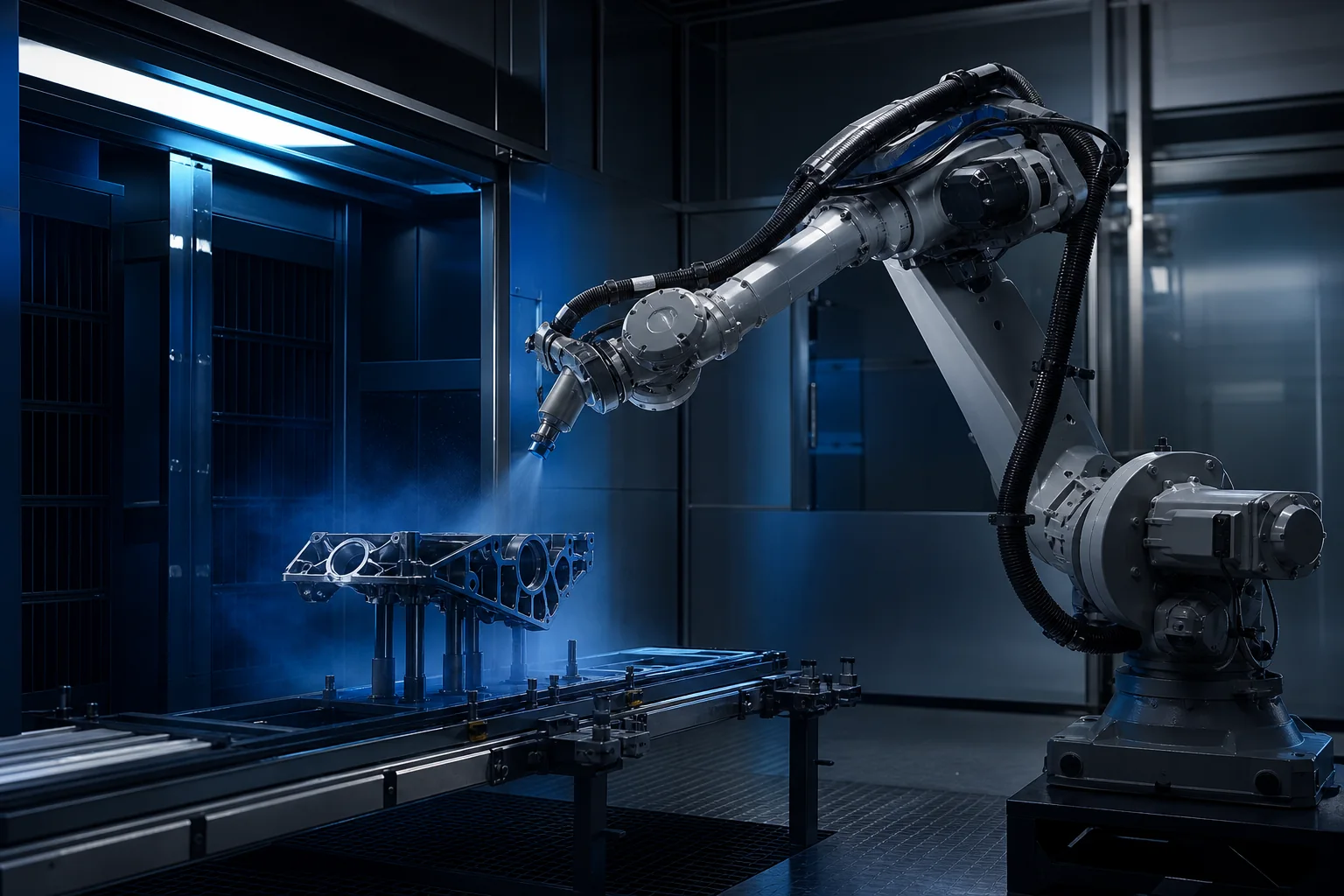
A practical layout guide for manufacturers planning robotic painting lines, covering spray booth design, conveyor flow, part positioning, robot reach, drying, controls, safety and quotation data.
Why Layout Is the First Engineering Question
A robotic painting project should not begin with a robot model. It should begin with the production flow. The layout determines how parts enter the system, how they are positioned, how coating is applied, how overspray is controlled, how parts dry or cure, and how operators load, unload and maintain the line. If the layout is weak, even a strong robot platform will struggle to deliver stable finish quality. Kynex Robots approaches robotic painting as a complete system integration project where robot options, spray booth, conveyors, fixtures, controls and commissioning are planned together.
Start With the Product Family and Part Envelope
The product family defines the working envelope of the painting line. Buyers should prepare representative drawings, photos, dimensions, weight, hanging points, fixture method and surface requirements. A line designed for small metal brackets will be very different from a line designed for furniture panels, plastic covers or automotive parts. The largest product determines booth clearance, robot reach, conveyor width and maintenance space, while the smallest product can affect fixture density and line speed. Product variation should be grouped into families so the layout is not overdesigned for rare exceptions.
Part Flow Determines Booth and Conveyor Direction
Part flow is the path from loading to painting, flash-off, drying or curing, cooling, inspection and unloading. In some factories, a straight conveyor is the simplest option. In others, a U-shaped line saves space and keeps operators near loading and unloading. For batch production, an indexed conveyor, trolley system or turntable may be more practical than a continuous conveyor. The correct flow depends on target output, color change frequency, available floor space, product size and how upstream or downstream processes connect to the painting area.
Spray Booth Layout Must Support Robot Motion and Airflow
The spray booth is not only a box around the robot. It must support robot movement, coating quality, overspray control, maintenance access and safe operation. Booth width, height, access doors, lighting, exhaust, filtration and airflow direction all affect production stability. A robot mounted too close to the product may have poor spray angles. A robot mounted too far away may waste reach or require a larger booth. Airflow must remove overspray without disturbing coating transfer efficiency. If the project involves solvent-based coating, explosion protection, ventilation and compliant electrical design become even more important.
Robot Mounting Changes the Entire Line Concept
Painting robots can be floor-mounted, wall-mounted, ceiling-mounted or mounted on tracks depending on the part and booth layout. Floor mounting is common and practical, but it consumes booth floor area. Wall or ceiling mounting can improve access and keep the floor cleaner, but it may increase structural and maintenance requirements. A rail or track can extend coverage for long parts, but it adds cost, controls complexity and maintenance needs. The mounting method should be chosen after reviewing part geometry, spray path, booth dimensions, maintenance access and future product variation.
Conveyor Accuracy Affects Finish Quality
Robotic painting depends on predictable part position. If the conveyor, hanger, fixture or trolley allows the part to swing, rotate unpredictably or stop at different positions, the programmed spray path will not match the surface. This can create uneven film thickness, missed edges, excessive overspray or quality variation. Conveyor design should consider line speed, indexing accuracy, hanger stiffness, part spacing, loading method, grounding when required, contamination risk and how parts are identified by the control system. For many projects, stable fixturing and part positioning are just as important as robot repeatability.
Drying and Curing Space Must Be Planned Early
A painting line often needs flash-off time, drying time, curing time or cooling time after coating. These process times can require more floor space than the robot booth itself. If drying is underestimated, the line may produce bottlenecks even if the robot cycle time is fast. The layout should include product dwell time, oven length, temperature requirements, air circulation, energy use, part spacing and unloading temperature. When the process uses multiple coatings or primers, intermediate flash-off and handling requirements must be included in the line concept.
Color Change Strategy Affects Layout and Equipment
Factories with frequent color changes need a different layout and spray equipment plan from factories running one color for long batches. Color change can affect pump selection, piping, flushing, waste management, robot program management and production scheduling. If colors change often, the layout may need easier access for cleaning and more careful material handling. If products are grouped by color or batch, the conveyor and production plan can reduce changeover loss. Buyers should provide current color count, color change frequency, coating material and cleaning method before requesting a robotic painting proposal.
PLC and HMI Should Coordinate the Whole Painting Line
A robotic painting line needs more than robot programming. The PLC and HMI coordinate conveyors, booth signals, spray equipment, safety interlocks, recipe selection, alarms, loading stations and possibly ovens or drying systems. Operators should be able to understand line status, select product recipes, respond to faults and recover safely after stoppages. The control architecture should define how the robot knows which part is arriving, when spraying can start, when the conveyor can move, and what happens if airflow, pressure, door status or safety devices are abnormal.
Safety and Maintenance Access Cannot Be Added Later
Safety fencing, access doors, emergency stops, booth interlocks, maintenance platforms, cleaning access and lockout points should be part of the first layout review. A painting line that is difficult to clean or maintain will lose uptime over time. Filters, spray guns, pumps, fixtures, nozzles, conveyor chains and sensors all need access. Operators also need safe loading and unloading positions with practical ergonomics. Retrofitting safety and access after equipment is installed usually creates compromises, so these requirements should be visible in the early layout drawing.
Manual Loading, Semi-Automatic Flow or Full Line Automation
Not every factory needs a fully automatic line from the first phase. Some projects start with manual loading and unloading, one robot booth and simple fixtures. Other projects require conveyors, automatic recognition, drying ovens and integrated downstream inspection. A phased approach can be more practical when product volume is growing or process data is still developing. The first phase should solve the main bottleneck while preserving space and control architecture for future expansion. Kynex Robots evaluates automation scope based on production requirements rather than pushing one fixed equipment package.
Quotation Data Needed for a Robotic Painting Line Layout
A useful layout proposal requires practical production data. Buyers should prepare product drawings, photos, dimensions, weight, material, coating type, surface quality requirements, current painting process, target output, shift schedule, color change frequency, available factory layout, existing booth or conveyor condition, drying requirements, utilities, safety requirements, preferred robot options, budget range and target schedule. Videos of current manual painting or current line operation are especially useful because they reveal handling, quality issues and bottlenecks that drawings alone may not show.
How Kynex Robots Supports Robotic Painting Line Layout Projects
Kynex Robots works as a robotic system integrator for manufacturers planning robotic painting systems. The work can include production flow review, robot option evaluation, spray booth integration, conveyor planning, fixture concept, spray equipment coordination, PLC/HMI control, safety design, installation, commissioning and after-sales support. Kynex Robots is not a robot manufacturer. The project value is in turning selected robot options and automation components into a reliable production system that fits the factory process.
FAQ: Is a Conveyor Always Required for Robotic Painting?
No. Some robotic painting projects use a fixed booth, rotating fixture or manual loading table. A conveyor becomes more useful when output is higher, product flow must be continuous, drying time needs coordination or parts must move through multiple process stages.
FAQ: What Is More Important, Robot Brand or Line Layout?
Robot platform matters, but line layout often has a larger effect on daily production. Booth size, part positioning, conveyor stability, spray equipment, controls, airflow and maintenance access determine whether the robot can perform consistently.
FAQ: Can an Existing Spray Booth Be Reused?
An existing booth can sometimes be reused, but it must be checked for dimensions, airflow, safety, access, lighting, exhaust, contamination risk, robot mounting space and compatibility with the required coating process. Reuse should be confirmed by engineering review rather than assumed.
Robotic Painting Line Layout Planning Matrix
| Layout Area | Engineering Decision | Data Buyer Should Prepare |
|---|---|---|
| Product envelope | Defines booth size, robot reach and fixture spacing | Drawings, photos, maximum dimensions, weight, hanging method |
| Part flow | Determines straight, U-shaped, indexed or batch layout | Target output, process sequence, loading and unloading method |
| Spray booth | Controls robot motion, airflow, overspray and maintenance access | Coating type, booth limits, airflow needs, access requirements |
| Conveyor and fixtures | Stabilizes part position for repeatable robot paths | Line speed, fixture concept, hanger design, part spacing |
| Drying or curing | Prevents downstream bottlenecks after coating | Flash-off time, oven temperature, dwell time, cooling needs |
| PLC/HMI controls | Coordinates robot, conveyor, booth and safety signals | Recipe needs, sensors, existing controls, alarm workflow |
| Safety and maintenance | Protects operators and supports long-term uptime | Operator stations, cleaning access, emergency stop and door requirements |