A practical guide for manufacturers explaining robotic painting system components, workflow, engineering decisions, cost drivers and quotation data requirements.
What a Robotic Painting System Actually Includes
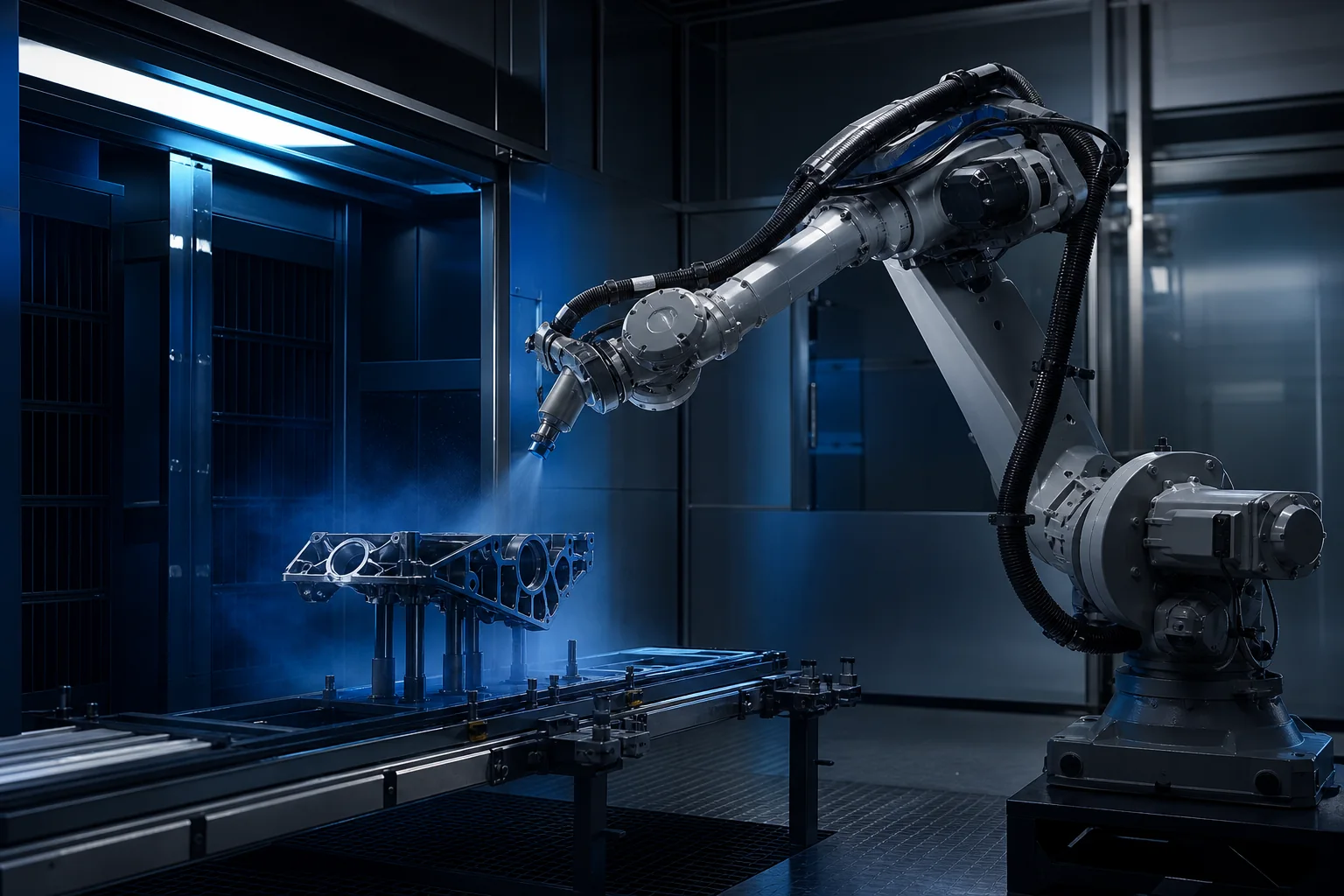
A robotic painting system is not only a robot arm installed inside a spray booth. For a factory buyer, the useful definition is a complete production system that can move parts, position them repeatably, apply coating with controlled parameters, manage overspray, protect operators, and communicate with the rest of the production line. A typical system may include one or more painting robots, spray guns, pumps, mixing equipment, booths, conveyors, fixtures, electrical cabinets, PLC/HMI controls, safety devices, air handling and commissioning support. The robot is important, but the integration around the robot determines whether the line can run every day with stable quality.
Why System Integration Matters More Than the Robot Model Alone
Many manufacturers begin by asking which robot brand is best. That question is understandable, but it is not the first engineering decision. The best robot option depends on part size, booth space, coating process, working envelope, service needs, explosion-proof requirements, cable routing and production rhythm. A strong robot platform can still perform poorly if the conveyor is unstable, the booth airflow is unsuitable, the fixture allows part movement, or the PLC logic does not coordinate the line correctly. Kynex Robots approaches robotic painting as a system integration project: selected robot brands are evaluated based on project requirements and then integrated with process equipment and controls.
Core Workflow of a Robotic Painting Line
A robotic painting line usually starts with loading or hanging parts, followed by positioning, surface preparation if required, automatic spray application, flash-off or drying, unloading and inspection. In a conveyorized line, parts move through these steps continuously or in indexed positions. In a robotic painting cell, parts may be loaded manually or by fixture, and the robot follows a programmed spray path. The key workflow question is whether the part arrives at the same location and orientation every cycle. If the part position changes, the robot path will not match the surface and coating quality becomes inconsistent.
Main Equipment Modules in the System
The main modules can be grouped into robot platform, spray process equipment, booth and ventilation system, part handling system, electrical and control system, and safety architecture. The spray process equipment may include liquid or powder application devices, pressure control, pumps, color change units and cleaning functions. The handling system may include a conveyor, indexing unit, rotary table, fixture or manual loading station. The control system connects robot signals, conveyor movement, booth interlocks, alarms and operator interface. A quotation should make these modules clear because different scope levels lead to very different project cost and delivery time.
How Product Geometry Affects Robot Selection
Product geometry controls reach, path planning and fixture design. A flat panel is easier to paint than a deep box, a complex metal frame or a part with hidden inner surfaces. The robot must maintain suitable spray distance, angle and overlap while avoiding collisions with the part, fixture and booth. Large parts may require a longer reach robot, an external axis or a moving conveyor strategy. Small parts may require multiple fixtures or batch loading to keep output efficient. Before selecting a robot, manufacturers should prepare drawings, photos, dimensions, weight, material and surface quality requirements.
Spray Booth and Airflow Are Process Decisions
The spray booth is not just a protective enclosure. It controls overspray movement, airflow, operator safety, maintenance access and coating environment. Booth dimensions must leave enough space for the robot envelope, the part path and service access. Airflow direction and extraction capacity affect paint mist control and finish quality. Door positions, lighting, filtration, fire safety and interlocks must also be considered. If an existing booth will be reused, the integrator must check whether the robot can be mounted safely and whether the booth can support automatic spraying without creating quality or safety problems.
Conveyor and Fixture Repeatability Drive Quality
Robotic painting depends on repeatable part presentation. A conveyor that swings, stops inconsistently or changes part spacing will create unstable spray results. Fixtures must hold the product in a predictable orientation without blocking important surfaces. For hanging parts, hook design and part balance matter. For table fixtures, location pins, clamping and operator loading method matter. In many real projects, improving part positioning gives more quality improvement than changing robot model. Repeatability should be reviewed early because it affects robot programming, cycle time, coating uniformity and rework rate.
Cost Factors Buyers Should Understand
The cost of a robotic painting system depends on system scope, not only robot price. Major cost drivers include robot quantity and type, spray equipment, booth modification or new booth supply, conveyor length, fixtures, electrical cabinets, PLC/HMI programming, safety hardware, installation, commissioning and training. Product complexity and color change frequency can also increase engineering work. A low initial equipment price may not be the best value if it excludes fixtures, controls, booth integration or commissioning. A practical quotation should define what is included, what is optional and what assumptions were used.
Data Needed Before Requesting a Quotation
Factories can speed up quotation and reduce misunderstanding by preparing a clear data package. Useful materials include part drawings, photos or videos, dimensions, weight, material, current painting method, coating type, target film thickness, quality standard, hourly output, shift schedule, factory layout, existing booth or conveyor condition, utility availability, budget range and expected delivery date. If the product family has many variants, representative samples should be listed. This allows the integrator to evaluate whether a single robot cell, conveyorized line or phased automation approach is most practical.
Common Mistakes in Early Project Planning
A common mistake is buying a robot first and solving the rest of the line later. Another mistake is assuming that manual spray paths can be copied directly without changing fixtures, booth layout or part flow. Some projects underestimate safety, ventilation, cleaning, color change and maintenance access. Others focus only on maximum output and forget loading time or inspection workflow. A better approach is to define the production problem, collect product and process data, evaluate integration scope and then select the robot option that fits the complete system.
How Kynex Robots Supports Painting Automation Projects
Kynex Robots works as a robotic system integrator for manufacturers planning robotic painting and automation line projects. The work may include robot option evaluation, system layout, spray booth integration, conveyor coordination, fixture planning, PLC/HMI control, installation, commissioning and after-sales support. Kynex Robots does not need to present itself as a robot manufacturer. The value is in selecting suitable robot options based on project requirements and integrating them into a working production system.
FAQ: Is Robotic Painting Suitable for Small Batches?
Robotic painting can support small or medium batches when product families are repeatable and fixtures are designed for changeover. The economics depend on setup time, color changes, programming effort, labor availability and quality requirements. For highly variable one-off parts, a hybrid approach may be more practical.
FAQ: What Determines the Payback Period?
Payback depends on labor cost, defect reduction, coating savings, output stability, safety improvements, rework reduction and the number of operating shifts. A realistic ROI discussion should use the factory current process data rather than a generic promise.
FAQ: Does Kynex Robots Sell Officially Authorized Robot Brands?
Kynex Robots presents robot platforms as selected robot brands and robot options for integration based on project requirements. Official distributor or authorized agent language should only be used when a formal authorization exists.
Robotic Painting System Cost and Engineering Impact Matrix
| Factor | Typical Impact | Buyer Data to Prepare |
|---|---|---|
| Part size and geometry | Affects robot reach, spray path, booth layout and fixture design | Drawings, photos, dimensions, weight, surface areas |
| Coating process | Affects spray equipment, film thickness control, cleaning and color change design | Coating type, color count, target quality, current defects |
| Booth and airflow | Affects safety, overspray control, finish quality and maintenance access | Existing booth layout, airflow direction, available space |
| Conveyor and fixtures | Affects repeatability, cycle time, loading workflow and coating consistency | Line speed, hanging method, fixture photos, output target |
| Controls and safety | Affects uptime, operator workflow, interlocks and maintainability | PLC requirements, safety standard, operator process, alarm needs |
| Commissioning scope | Affects project delivery risk and final production readiness | Factory schedule, acceptance criteria, training needs |