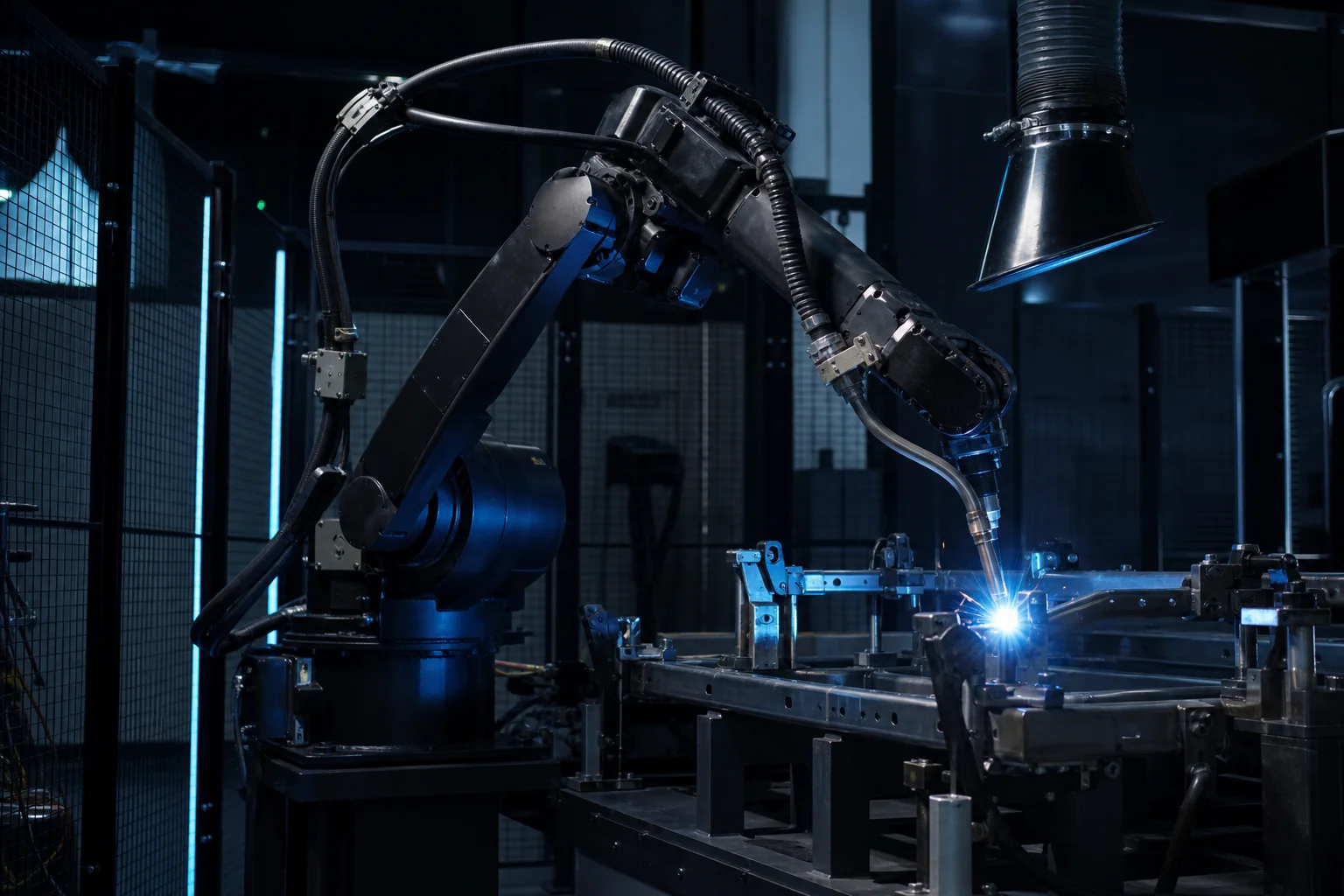
A practical feasibility checklist for manufacturers evaluating robotic welding automation, including part repeatability, weld access, fixtures, cycle time, safety and integration scope.
Start With Part Repeatability
Robotic welding works best when parts arrive in a repeatable position with controlled tolerances. If the same part varies too much between batches, the first engineering task is usually fixture and process stabilization, not robot model selection.
Check Weld Access Before Selecting the Robot
The robot must reach each joint with the torch, cable package, nozzle angle and safety envelope included. A reach number from a product catalog is not enough; the actual part orientation, fixture clamps and positioner movement must be evaluated together.
Evaluate Fixture Strategy Early
A good fixture controls location, clamping, distortion and loading workflow. For many welding projects, fixture quality has more impact on production stability than the robot brand itself.
Define Cycle Time and Output Requirements
Factories should compare current manual welding time, target output, loading time, tack welding requirements and inspection steps. This helps determine whether one robot cell, dual-station loading or a positioner-based layout is more practical.
Include Welding Equipment and Process Package
A robotic welding system is not only a robot arm. The welding power source, torch, wire feeder, anti-collision unit, fume extraction, safety guarding, PLC/HMI and operator interface must be planned as one working system.
Confirm Safety and Operator Workflow
Safety fencing, light curtains, emergency stops, fume extraction, maintenance access and loading ergonomics should be designed before final quotation. A productive welding cell must be safe to operate and practical to maintain.
Prepare Data for a Reliable Quotation
Useful quotation data includes part drawings, photos, material, thickness, weld length, joint type, production volume, factory layout, preferred robot options, budget range and expected delivery schedule.
FAQ: When Is Robotic Welding a Good Fit?
Robotic welding is usually a strong fit when parts are repeatable, weld paths are accessible, production volume is stable and fixture design can control part position. It is less suitable when every part is highly different or the process changes before each batch.
FAQ: Does Kynex Robots Manufacture Welding Robots?
No. Kynex Robots is a robotic system integrator. The project approach is to evaluate selected robot brands and integrate the suitable robot with welding equipment, fixtures, controls, safety systems, installation and commissioning.